|
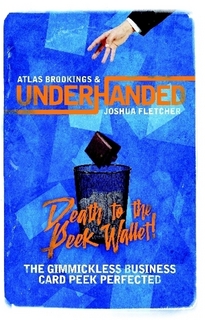
Underhanded by Atlas Brookings and Joshua Fletcher
|
|
Why take a business card out of your wallet, have someone write or draw on it, and then put it back into your wallet? Unless the participant is giving you their business card, this makes little sense. Underhanded is simply...
The Death of the Peek Wallet!
Underhanded is honestly the easiest, cleanest, most direct piece of peekery out there. It gives you a full business card peek, is easy to do, requires no gimmicks, and is just plain, full blown awesome super best number one! No nonsense, this thing is a beast, a straightforward, low tech workhorse that gives people a reason to hang on to your business cards. And there is nothing to find. You are so clean, it looks like you work for the CDC... ummm... because I'd expect those guys to be pretty fastidious about cleanliness. I could be totally wrong though and that analogy doesn't track.
But I think it does? Doesn't it?
Anyhow...
Apart from teaching the "Underhanded" method, this book comes with a number of routines, each truly refined through performance at numerous gigs. In fact, the book contains my drawing dupe, Epic Triple Fail, that isn't really a dupe but is probably one of the most powerful reveals I use (really, it makes the ladies hyperventilate... something I've always wanted to be able to say, but I mean it - they are frequently so unexpectedly and suddenly stunned that they forget to breathe and you get that sudden intake of breath and unrepeatable stream of sailor speak), as well as the Epic Q and A - a fantastic mind reading Q and A with three people that leaves EVERYONE floored.
Why buy expensive electronics or peek wallets? Use a low tech method that is truly Underhanded.
It is hard to envision a piece of mind reading that is any more direct! |
|
Price 37.00 GBP |
|
We Meet Again, Doctor Jones by Atlas Brookings
|
|
When Andrew Brown and Atlas Brookings released The Crusade in 2013, it was to wide spread acclaim, loved by both reviewers and performers all over the world and hailed as an instant classic, with over 1,000 copies sold to date! Doctor Jones is simply...
The Latest Instalment in a Legendary Franchise An Impossible Thought of Card at a Thought of Number effect, reminiscent of The Crusade both in presentation and impact, but which ONLY requires a single participant. Doctor Jones uses tried and tested principles to which have been added subtleties in technique and presentation which have been refined and honed through countless real world performances. This is a self contained effect, unique in methodology, and does not require knowledge of The Crusade in order to perform. As with The Crusade, Doctor Jones can be performed with a borrowed, shuffled deck, and requires no sleight of hand whatsoever. Moreover, Doctor Jones requires only one participant, allows them to freely choose their number, and ensures that the performer never knows the quantity or contents of the packet used. It is hard to envision a piece of mind reading that is any more direct! |
|
Price 14.00 GBP |
|
The Intrepid Rogue's Manual of Deception by Atlas Brookings
|
El Señor De Los Anillos: La Comunidad Del Anillo !!install!! 【2027】Furthermore, the Ring’s effect on Gollum, a creature once a hobbit-like being, serves as a dark mirror for Frodo. Gollum’s degradation shows the long-term consequence of bearing the Ring: the erasure of self and the reduction of all desire to possession. Thus, the physical journey from Hobbiton to Rivendell is also a spiritual descent into the gravity of evil. Classical epic heroes—Achilles, Beowulf—are defined by strength, lineage, and martial prowess. Frodo Baggins is defined by none of these. He is an unlikely hero, a bachelor hobbit of moderate means. Yet, Tolkien argues that humility and endurance are higher virtues. Frodo’s primary battle is internal: the increasing weight of the Ring on his spirit. At the end of The Fellowship , following the death of Gandalf in Moria and Boromir’s attempt to seize the Ring, Frodo chooses to continue the quest alone. This decision is not cowardice but the highest form of responsibility. He realizes that the Fellowship cannot protect him from the Ring’s influence over them . Abstract J.R.R. Tolkien’s The Fellowship of the Ring (1954), the first volume of The Lord of the Rings , is more than a high fantasy adventure. It is a profound exploration of power, temptation, and the moral necessity of unity against seemingly insurmountable evil. This paper argues that the novel establishes the central conflict of the saga through the symbolic weight of the One Ring, examining how Tolkien constructs a heroic journey that subverts traditional martial masculinity in favor of humility, loyalty, and the preservation of the mundane. Through the formation of the Fellowship, Tolkien presents a model of resistance rooted not in might, but in diverse cooperation and the courage of ordinary beings. 1. Introduction Published seventeen years after The Hobbit , The Fellowship of the Ring introduces readers to a darker, more politically complex Middle-earth. The novel opens in the pastoral tranquility of the Shire, home to the hobbits—a race defined by their love of simple pleasures. However, the discovery that the magic ring left by Bilbo Baggins is in fact the One Ring of the Dark Lord Sauron shatters this peace. This paper will analyze three key aspects: the symbolic nature of the Ring as corrupting power, the evolution of the protagonist Frodo Baggins, and the significance of the Fellowship as a microcosm of free peoples united. 2. The One Ring: A Symbol of Absolute Power and Its Corruption The Ring is not merely a tool of invisibility; it is a sentient extension of Sauron’s will. Tolkien articulates a moral cosmology where power itself is inherently corrupting. Unlike later fantasy tropes where magical artifacts amplify heroic abilities, the Ring preys on ambition. This is exemplified in the Council of Elrond, where Boromir, the noble warrior of Gondor, is already tempted by the idea of using the Ring against Sauron. Tolkien critiques the utilitarian argument that "the end justifies the means" by showing that any attempt to wield the Ring would ultimately serve Sauron’s purpose. el señor de los anillos: la comunidad del anillo Frodo’s mercy toward Gollum, advocated earlier by Gandalf, becomes a crucial plot point. While not yet realized in this volume, this mercy establishes Tolkien’s theme that pity and forgiveness are strategic and moral weapons more powerful than swords. The titular Fellowship, formed at Rivendell, comprises nine companions: four hobbits (Frodo, Sam, Merry, Pippin), the Elf Legolas, the Dwarf Gimli, the Man Boromir, and the Wizard Gandalf. This number mirrors the nine Nazgûl (Ringwraiths), suggesting a deliberate opposition. However, unlike the uniformity of Sauron’s servants, the Fellowship is diverse and fractious. The initial tension between Legolas and Gimli, rooted in ancient racial enmity between Elves and Dwarves, is gradually overcome through shared hardship. Tolkien suggests that unity is not natural but must be forged. Furthermore, the Ring’s effect on Gollum, a creature |
|
* SOLD OUT * |
|
Atlas Brookings Penguin Live Lecture DVD The Power of Propless Mentalism
|
|
OWN THE BEST REVIEWED PENGUIN LECTURE OF 2015! "Atlas is a new friend and a talented one. I always look forward to everything he is willing to share and you should do the same." - Michael Weber
What will he teach? The Power of Impromptu, Propless Mentalism Join Atlas as he examines the strengths and limitations associated with propless mentalism techniques. He'll discuss when to go propless, the correct way to present the material, and how to handle those situations when things don't go exactly as you'd planned - teaching you the right and wrong way to fail when using these approaches. Tune in and discover how to do some amazing things when you have only your wits about you. At this lecture, Atlas will teach you some of his favorite propless effects, many of which have never been published before: CloudNine - A short personality reading that finishes with telling someone the day, month, and year they were born. Comicle - Tell someone the name of the superhero they are thinking of. Disney Dynamite - Name the animated Disney film you participant has in mind. Forward Thinking - You play an association game wherein your participant only answers in their mind and selects only one of the responses they freely thought of. You then reveal their thoughts. Imbalanced - An impromptu murder mystery game, wherein you not only name the murderer, but you reveal whether someone chose to be honest or to attempt to deceive you. Speed Trap - Within moments of meeting someone, tell them the make and color of the car they have in their garage at home. Quinnfluence - A series of free choices lead three participants to three random thoughts, which are then promptly revealed.
|
|
Price 18.00 GBP + FREE Shipping |
|
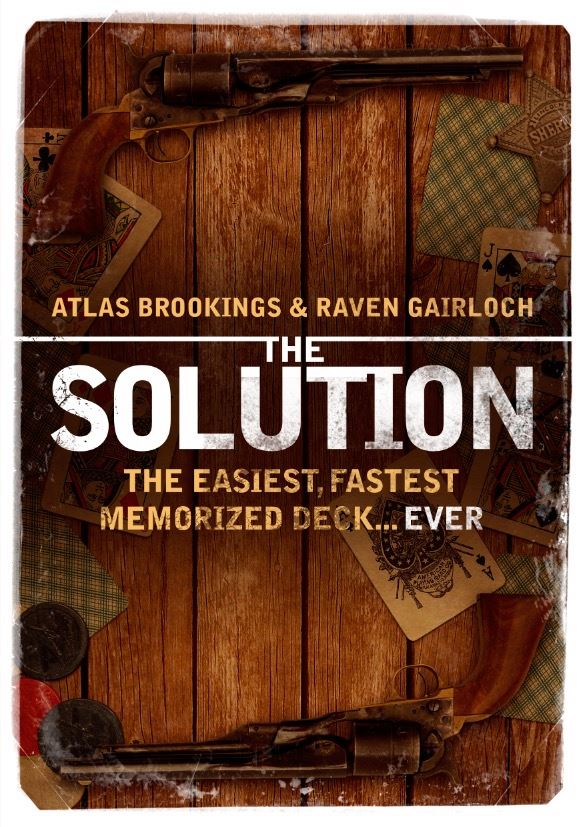
The Solution by Atlas Brookings and Raven Gairloch
|
|
There are some pretty cool things that you can do with a memorized deck. The only trouble is that you have to memorize 52 cards in 52 positions. Not only can that prove challenging, but it is incredibly time consuming and requires constant work to move that information from your short term to your long term memory. Understandably, not many people make the effort. But what if you could memorize the position of every card in a deck in a matter of minutes - And then recall that deck order for the rest of your life? This ability adds a versatility to your card repertoire that is WORTH having. Don't think you can do it? Well, you can. How is this possible? Why does this work? Take a look at the Solution deck below:
In an ideal world, there wouldn't be any compromise - You'd be able to quickly memorize a deck that could also be freely displayed and handled by a participant. You'd have your cake and eat it too. I'm pleased to say that this is now possible with 'The Solution'. The Solution is the deck that I referenced during my Penguin Live Lecture - a deck that you can memorize in minutes and openly fan and display. The book - running to 120 pages - not only outlines the system, but also comes with several routines that have been created specifically for someone who wants to perform as a mind reader.
|
|
Price 27.00 GBP + 3.00 GBP Shipping |
|
The Prodigal by Atlas Brookings
|
|
Furthermore, the Ring’s effect on Gollum, a creature once a hobbit-like being, serves as a dark mirror for Frodo. Gollum’s degradation shows the long-term consequence of bearing the Ring: the erasure of self and the reduction of all desire to possession. Thus, the physical journey from Hobbiton to Rivendell is also a spiritual descent into the gravity of evil. Classical epic heroes—Achilles, Beowulf—are defined by strength, lineage, and martial prowess. Frodo Baggins is defined by none of these. He is an unlikely hero, a bachelor hobbit of moderate means. Yet, Tolkien argues that humility and endurance are higher virtues. Frodo’s primary battle is internal: the increasing weight of the Ring on his spirit. At the end of The Fellowship , following the death of Gandalf in Moria and Boromir’s attempt to seize the Ring, Frodo chooses to continue the quest alone. This decision is not cowardice but the highest form of responsibility. He realizes that the Fellowship cannot protect him from the Ring’s influence over them . Abstract J.R.R. Tolkien’s The Fellowship of the Ring (1954), the first volume of The Lord of the Rings , is more than a high fantasy adventure. It is a profound exploration of power, temptation, and the moral necessity of unity against seemingly insurmountable evil. This paper argues that the novel establishes the central conflict of the saga through the symbolic weight of the One Ring, examining how Tolkien constructs a heroic journey that subverts traditional martial masculinity in favor of humility, loyalty, and the preservation of the mundane. Through the formation of the Fellowship, Tolkien presents a model of resistance rooted not in might, but in diverse cooperation and the courage of ordinary beings. 1. Introduction Published seventeen years after The Hobbit , The Fellowship of the Ring introduces readers to a darker, more politically complex Middle-earth. The novel opens in the pastoral tranquility of the Shire, home to the hobbits—a race defined by their love of simple pleasures. However, the discovery that the magic ring left by Bilbo Baggins is in fact the One Ring of the Dark Lord Sauron shatters this peace. This paper will analyze three key aspects: the symbolic nature of the Ring as corrupting power, the evolution of the protagonist Frodo Baggins, and the significance of the Fellowship as a microcosm of free peoples united. 2. The One Ring: A Symbol of Absolute Power and Its Corruption The Ring is not merely a tool of invisibility; it is a sentient extension of Sauron’s will. Tolkien articulates a moral cosmology where power itself is inherently corrupting. Unlike later fantasy tropes where magical artifacts amplify heroic abilities, the Ring preys on ambition. This is exemplified in the Council of Elrond, where Boromir, the noble warrior of Gondor, is already tempted by the idea of using the Ring against Sauron. Tolkien critiques the utilitarian argument that "the end justifies the means" by showing that any attempt to wield the Ring would ultimately serve Sauron’s purpose. Frodo’s mercy toward Gollum, advocated earlier by Gandalf, becomes a crucial plot point. While not yet realized in this volume, this mercy establishes Tolkien’s theme that pity and forgiveness are strategic and moral weapons more powerful than swords. The titular Fellowship, formed at Rivendell, comprises nine companions: four hobbits (Frodo, Sam, Merry, Pippin), the Elf Legolas, the Dwarf Gimli, the Man Boromir, and the Wizard Gandalf. This number mirrors the nine Nazgûl (Ringwraiths), suggesting a deliberate opposition. However, unlike the uniformity of Sauron’s servants, the Fellowship is diverse and fractious. The initial tension between Legolas and Gimli, rooted in ancient racial enmity between Elves and Dwarves, is gradually overcome through shared hardship. Tolkien suggests that unity is not natural but must be forged. |
|
Price 28.25 GBP + 3.00 GBP Shipping |
|
The Real Thing by Atlas Brookings
|
|
When this routine was first released in the Pyscrets publication 'Liber Mentis', it created quite a stir. It offered a means of performing both a lie detector type routine as well as an incredibly clean and direct mind read, devoid of any standard form of method. At the time, the text was only available through the Psycrets publication, but, after the widespread approval it received, the text has been reworked and dramatically extended, offering 22 more pages of additional material. This new material not only contains another means of performing a clean, impromptu, and apparently impossible mindread, but it contains instructions for a book test that is unlike anything you have ever seen before! Imagine being able to have someone choose a word from a book, close the book and set it aside, and then change their word to any other word they can think of (and I'm not talking about a different word from the book, but any other word they can think of) - only to have the performer subsequently reveal their new word with NO fishing! For the first time, this extended version of 'The Real Thing' teaches you how to do this and much more! Released publicly through this site for the first time, this text contains an astonishing array of impromptu routines! Any time you are asked to perform a feat of mind reading, all you need is a pen and something to write on. For example: On five (or more) different pieces of paper (business cards work well) you write a unique sentence, folding each card as you finish. What do other Mentalists think? "At last a routine where you really are doing what you claim! This is a fantastic concept that Atlas has expanded greatly. It has the feeling of real mentalism because it IS real mentalism." - Marc Paul "Page seven of your manuscript is worth whatever you end up charging for it." - Dave Arch "I really enjoyed 'The Real Thing'...The core of the effect uses pure psychology which is just the ticket. The way in which this has been used to create a nice little lie-detector routine is very clever indeed." - Derek Heron "Rather than a physical peek, your method is kinda like a mental peek!" - Seamus Maguire "I must say I really enjoyed reading 'The Real Thing'. If nothing else, it has gotten me thinking and that's when I know I'm taken by an idea." - Nique Tan "Thank you for making my copy of 'Naked Mentalism' relevant again!" - Aaron Alexander "Atlas has open up a world of possibilities here. Using this knowledge you can play mind detective and catch your criminal every time. Very sneaky stuff. Excellent." - Greg Arce "When I first released Naked Mentalism back in 2007, I hoped that others would run with it and create simple, subtle, yet powerful effects that really do feel real. With 'The Real Thing', Atlas has certainly done that. It's a tour de force; intelligent, clean and yet very reliable. Lovely work." - Jon Thompson And all of the above feedback was given BEFORE the additions to the text! Here is a review of "The Real Thing - Extended Version" featured in April's Vanish Magazine:
"Is it really possible to read minds? After reading this e-book I believe I can, at least that's how I felt. Inspired by Jon Thomspons Naked Mentalism, Atlas has taken the method to another level. I have been doing this and it really works, so it's not some pipe dream. It is very easy to understand and this book is well written so you don't have to be afraid of psychological thinking. I couldn't wait to try it out on friends after reading and it blew them away. The great thing is once you have learnt this you'll have some incredibly powerful impromptu mentalism that will fool people badly.
THIS IS AN ENGLISH ONLY EFFECT! |
|
Price 23.00 GBP + 3.00 GBP for Shipping |
|
The Crusade - A Mind Reader's ACAAN by Andrew Brown and Atlas Brookings
|
|
Imagine it: The cards rest on the table in front of your first participant, who gingerly takes them up and begins to count down to his secret number - a number that has never been written down, verbalized, or communicated to any other person. He counts down slowly, card after card, and then, abruptly, stops. He pauses and sets this last card aside. He has never said a word about his number. There is no way that you could have known what it was. He is confident of that. He slides the card across to the young lady next to him. Her thoughts have been focused on an image - a suit and a value. Again, her choice of card has never been shared. It has never been withdrawn from the pack, never touched and certainly not forced. She could have been thinking of any card in this deck. Her hand drifts toward the card on the table. The one separated just now by her boyfriend from the rest of the pack. The one resting at the number that he was merely thinking of. She hesitates. The deck is their own, they shuffled it before you ever touched it. They called all the shots every step of the way. Neither participant has ever given any indication what it was that they were thinking of, and neither believes in the ability to read minds... and yet...if the card she was merely thinking of is here, at the number that he was merely thinking of... As though she is reaching out to touch her own delicate skepticism, her fingers flit tentatively across the card on the table - her card. And as she reveals its face, she gasps - it is the Queen of Clubs - but it is more than that. It is belief, radiant and beautiful and glorious, a moment of dawning acceptance that will be remembered because it defied all her reason and filled her ideology with doubt. It is a moment of pure enchantment. And you made it happen with a borrowed deck of cards that they shuffled before you ever started. Take A Moment And Enjoy An Excerpt From The Text: INTRODUCTION Before we look at anything even remotely to do with methodology, let's first take a moment to examine the origins of this title. This exercise is undertaken in the hope that you will find beauty in its layered complexity and reassure yourself that the same sort of attention to detail and search for perfection in arriving at a title for this book is the standard offered by these authors throughout this document. Why is this called 'The Crusade: A Mind Reader's ACAAN'? To many in the magic industry and to card magic enthusiasts especially, the 'Any Card At Any Number' plot is a cherished and well-loved miracle. It's perfect execution is so highly prized and sought after that it is popularly referred to among card enthusiasts as the 'Holy Grail'. That begs the question - was this title merely a clever play on words? It is true that the Crusades and The Holy Grail are linked in popular lore. But while the association is interesting, there is more at work here than just opportunistic wordplay. You see, the Holy Grail was the destination, the final prize at the end of these stories of persistent knights and daunting expeditions, whether they have their basis in fact or fiction. It bears emphasizing once more - the Grail was the destination. The merits of the ACAAN effect have been argued back and forth for many years in the magic community. For some, their appreciation for the effect is akin to that of a fine wine and their devotion to it never wavers. Others, however, despise the plot and note sourly that the reaction from the audience is frequently less than enthusiastic. One person names a card and the other names a number and lo and behold - they match! It is over so quickly that it often plays as a puzzle rather than as an amazing feat that fills a person with wonder. The argument rages back and forth, and fruitful and enlightening perspectives have emerged. Some claim that the weaknesses lie in a lack of performance ability. Others argue that the plot is fundamentally unappealing to any demographic but magicians. The most experienced among us have consistently demonstrated that an individual will fail to recall the workings of a puzzle, but when they are escorted into an experience that fills them with wonder - when you take them on a journey that creates that wonder - they will never forget their sense of amazement or the guide that lit their path. So, in the title 'The Crusade', you have a reminder that what you are presenting is about the journey and not the mythical Holy Grail that is at the end of it. In folklore, the term 'Crusade' has also shaken off its religious overtones and become synonymous for a period of endeavor and path to improvement - the path, mind you, NOT the destination - which, in many ACAAN plots is arrived at too quickly to have any impact. One other important point about the title of this book. The root of the word 'Crusade' is the Latin word cruc or crux - meaning cross. And, of course, a cross is formed at two points of intersection. And what is an intersection but the place where the roads taken by two different travelers on two unique journeys meet? This moment of meeting is what 'The Crusade' allows you to create. When the card that one person only thought of intersects at the number another person only thought of - the journey that you created for each of them becomes the destination, and an experience is formed that will create a sense of amazement whose memory will never fade. To a performer, that is The Holy Grail. And the path to the Grail is through the Crusade.
|
|
Price 19.00 GBP + 3.00 GBP for Shipping |
Copyright © 2015 AtlasMentalism.com. All rights reserved by Atlas Brookings: Magician Nottingham, Magician Derby, and Magician Lincoln